
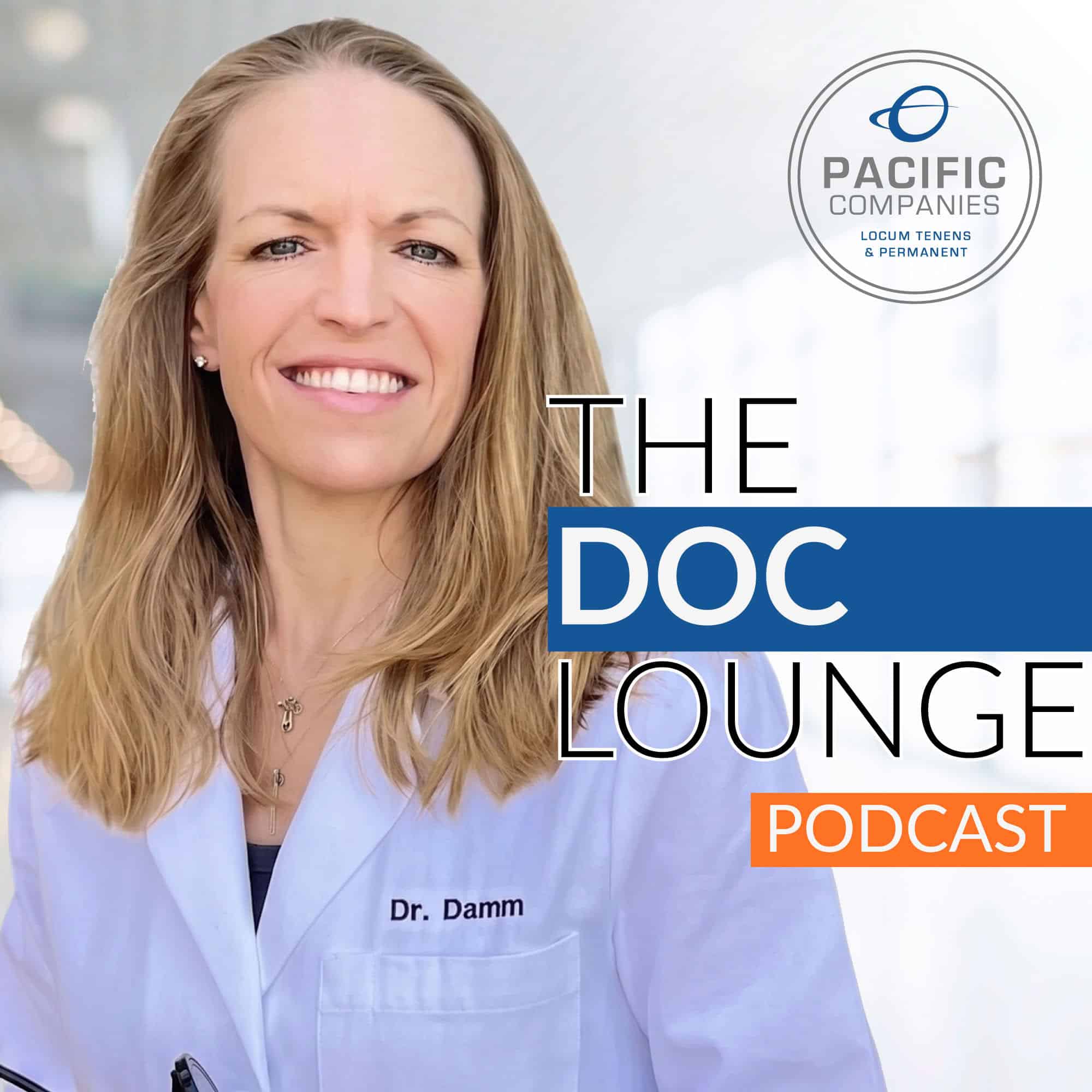

Dr. Tessa Damm spent a decade in the ICU watching heart attacks, strokes, and organ failure come through the doors. Her take: almost none of it was sudden. Those events are the final chapter of a metabolic story that started writing itself decades earlier.
In this episode:
– The triglyceride-to-HDL index, and how to read insulin resistance off a lipid panel you already have
– Why she says roughly 88% of adults have insulin resistance and hardly anyone gets screened
– Three changes she gives patients in their 30s, 40s, and 50s, including the post-meal walk
– How she restructured her clinical life, going part-time in the ICU to build a preventive practice
Tessa W. Damm, DO is quadruple board-certified in Internal Medicine, Critical Care Medicine, Neurocritical Care, and Lifestyle Medicine, and now leads the Metabolic Transformations program at Comprehensive Healthspan Management.
The Doc Lounge Podcast, hosted by Stacey Doyle. Brought to you by Pacific Companies.
Explore physician jobs → pacificcompanies.com
Connect with Dr. Damm → comphealthmgt.com/dr-damm
Subscribe wherever you listen.
#DocLoungePodcast #PacificCompanies #PhysicianPodcast #ICUPhysician #NeurocriticalCare #MetabolicHealth #InsulinResistance #Healthspan
—
FULL TRANSCRIPT
Stacey Doyle (00:01.758)
Welcome back to the Doc Lounge Podcast. I’m your host, Stacey Doyle, and today I’m excited to welcome Dr. Tr Tessa Dam to the show. Dr. Dam is a four-time board-certified physician with more than 25 years of experience in medicine, most recently caring for critically ill patients in the intensive care unit. After witnessing firsthand the devastating effects of heart attacks, strokes, and organ failure, she recognized a powerful pattern.
These life-changing events are rarely sudden. They’re often the result of metabolic dysfunction developing silently over decades. That realization inspired her to shift from treating disease at the end of the road to helping people prevent it in the first place. Today, through her metabolic transformation program, Dr. Dam focuses on comprehensive health span management, helping women better understand insulin resistance, mitochondria mitochondrial health.
Metabolic flexibility and the science of aging. She has a unique ability to take complex medical concepts and make them practical, actionable, and empowering. If you’ve ever wondered whether fatigue, brain fog, weight gain, or low energy are truly just part of getting older, this is a conversation you really won’t want to miss. So Dr. D, I’m so excited to have you on. Welcome to the Doc Lounge.
Dr. Tessa Damm (01:20.214)
Thank you. Happy to be here.
Stacey Doyle (01:22.986)
I know you’ve spent, you know, decades caring for some of the sickest patients in the ICU. So tell us, was there a particular patient or moment that changed how you thought about, you know, health and prevention?
Dr. Tessa Damm (01:37.771)
Interesting question. W way to kick it off. the moment most people would probably expect me to relay would be something dramatic in the ICU, but honestly, the moment for me was sitting on the floor in my own mother’s closet, sorting through her personal belongings after her sudden death. And that was a moment that for me brought together, I’m a visual person, so it brought together three pieces of my personal and professional life.
Stacey Doyle (01:40.158)
Hehehe
Dr. Tessa Damm (02:05.626)
And so if you can envision almost a Venn diagram, the the professional piece was as you just described, 25 years in healthcare, 10 or more of which were exclusively spent at the bedside in the ICU taking care of patients in kind of the on their worst days. another portion was personally, and I hadn’t really fully appreciated this until I put everything together. Personally, I experienced fairly dramatic shifts in my own health.
After having made unintentional, somewhat subtle shifts in my own nutritional strategy or diet. So I proved to myself the power of food as medicine. And then the third circle was the circumstances that led me there, sorting through my own mother’s belongings after her death, which I had watched her for about a decade deteriorate and eventually die with dementia. And the intersection of all those three circles, as I see it and put them together.
is metabolic dysfunction. It is what I had and was able to reverse without even knowing it before I realized it, what likely contributed to, largely contributed to my own mother’s dementia. And then also underlying metabolic dysfunction and chronic disease is what leads to about 70% of what eventually lands in an intensive care unit. So that was my moment of of kind of fully realizing and seeing things.
A little bit for the first time from a different perspective.
Stacey Doyle (03:36.386)
Right, ’cause you always had the clinical experience and then you’re combining it obviously with the most personal that there is. And it sounds like that was the moment where you said, Okay, I I I wanna change this up. Things need to be, you know, go differently. So Yeah.
Dr. Tessa Damm (03:51.061)
Yeah, I I think, you know, anyone listening to this who’s lost a family member, you certainly question like, what is this all for? What am I doing? Who’s gonna be sorting through my personal belongings? What can I do to prevent a similar fate? Right? These are all questions that I think a lot of people grapple with. And it usually isn’t until something happens personally that you really understand it from pr potentially a different perspective, but also ask different questions. So my question was what can I do?
For myself, my family, and my patients to keep them from experiencing what I see in the ICU and certainly what I saw unravel with my mother.
Stacey Doyle (04:30.412)
And I know this kind of so you were talking about this earlier. You said that, you know, heart attacks, strokes, organ failures, that’s usually the final chapter, but that’s been, you know, being written over decades. So what are those earliest chapters that you think most people overlook?
Dr. Tessa Damm (04:49.312)
Yeah. The the single most unifying process, in my opinion, my professional opinion, is metabolic dysfunction, which is a little bit of a garbage bucket term. It’s not very specific. When I use it, I’m specifically referring to insulin resistance, which is a condition that upwards of 88%, so rounding nine and ten of us have adults, and most of whom have no idea. It is not screened for nor recognized.
Stacey Doyle (05:20.526)
Can you ask for that screening and tell us how people out there listening would know, okay, wait, maybe I’m dealing with that sounds like most people are.
Dr. Tessa Damm (05:30.272)
Yeah, great question. So yes, you can ask for it. it’s a little complicated because you’d have to ask for a fasting insulin level as well as a fasting glucose level and then and then be working with a physician or practitioner who is willing to calculate what’s called a HOMA IR scale and see where you fit on that. But it’s even easier. Most people already have the lab work that’s required to determine whether or not it’s likely present.
And it’s it hides within your cholesterol plant panel or your lipid panel that many of us get routinely on annual physical exams. And typically, I was trained during my internal medicine training to really hone in on that LDL cholesterol, sometimes referred to as the bad cholesterol. And that’s what most of the guidelines talk about, and that’s how we how we determine who potentially needs medical management. But the other numbers that people rarely talk about that are on that same panel.
Your triglyceride level and your HDL level, those combine to form what I refer to as your metabolic signature. So a low triglyceride level and a high HDL are very favorable. And there’s actually an equation. You can, it’s called the triglyceride HDL index. You can divide, take your triglyceride level, divide by your HDL. And essentially, if it’s less than one, that’s fairly superb. If it’s two or more, that is suggestive of.
the presence of the process of insulin resistance. So yes, you can ask for it, or you can look at labs that most people already have, which I’m a fan of because I think it lowers the resistance to really understanding where maybe your metabolic starting point is.
Stacey Doyle (07:16.162)
Fabulous advice for everybody because I know that’s something like you’re saying that everybody typically gets annually. So now we know what to look for. So thank you for for sharing that. Now tell us, I know you’ve worked with a lot of high performing women who are, you know, they tell you, Hey, I’ve got fatigue, I’ve got w weight gain, I’ve got brain fog, I’m seeing hormonal changes. Is this just what aging is?
What what are some of the myths that you would like to challenge with all of your experience and knowledge?
Dr. Tessa Damm (07:49.794)
Yeah, I think that in general we do a really poor job of understanding what health is. And I think when I say we, I mean we as a society and we as a medical system. So as a society, studies show that like if we see a green drink, we think that means healthy. I was born in the 70s, largely raised in the eighties. So I was raised with the understanding that the food pyramid was healthy.
And it turns out the base of the food pyramid literally is the only macronutrient that is non-essential for human existence. And the protein and fat, which are essential nutrients, got really small little squares at the top. So I think for starters, it’s as a society we’ve kind of bred mis on an a misunderstanding of what truly actually yields quality health. And then within the medical system, again, I can speak.
From experience, because I had internship residency, chief residency, two fellowships, and then another board certification on top of it. And never once in my training was I actually taught the things that I now provide for people. So we are so inundated in our healthcare system with treatment of disease that there’s not room or space for truly fostering health.
So I think I think the biggest thing that I deal with, getting back to your question, and sorry I was droning on, is just a complete misunderstanding of what actually breeds health. And that’s a that’s a societal thing. And also anyone who thinks that going to the doctor to learn how to be healthy is the thinks that that’s sufficient. Our system’s really designed to assess for disease. Once it is diagnosable and we have a pill or something.
to treat it, not necessarily optimizing your existence up until then to avoid disease and instead thrive with health.
Stacey Doyle (09:53.218)
That makes a lot of sense because like you’re saying, it there it’s in a a system that’s inundated with with patients that need help and care for kind of triaging what is what’s wrong and and less more so about prevention. That’s why I love a lot of the things that you spend time teaching. One of the the most interesting ones that I thought was about mit mitochondria, that little tiny powerhouse that’s inside our cells. So tell us.
What would the average person want to learn about this? You know, why are they so important?
Dr. Tessa Damm (10:25.665)
Yeah. Well, mitochondria are essentially the primary site for energy production in our cells. So it’s where dietary nutrients are converted into cellular energy. And I’ll be honest, I usually avoid using that term because it seems so abstract to most people. And they’re like, mitochondria, I want to fit into my clothes, I want to feel energized, I want to right, not be on prescription medications. How does mitochondria kind of fit into that? But in
Kind of taking a broader brush stroke, metabolism, the definition of metabolism, is the sum of all chemical reactions that occur within the cells of a living organism to maintain life. That sounds important, right? and so I tie the two together with behaviors that we can do. So our metabolism is insanely complex. Insanely complex. Yet
It responds very consistently to simple intentional signaling. So I talk a lot about speaking the language of your metabolism, understanding what signal you’re sending by doing the things that you’re doing. So why would one prioritize protein and fat in their diet? what does that do to your metabolism? How does it receive that signal and then perform for you? So that’s how I kind of tie the two together: is an understanding that literally metabolism is needed.
for e for a living organism to maintain life and then how you communicate that to a cellular level, but doing so through the understanding of we have control over that based on what we’re doing in our everyday and metabolic signaling. Did that answer your question?
Stacey Doyle (12:06.734)
It did. That’s it’s fascinating. And I think it really talks to the science about things that we’re all trying to learn and understand that you have really, you know, embraced and and helped educate, you know, your patients on. So tell us if there’s somebody right now, you know, that could be in their thirties, forties, fifties, wanting to dramatically improve their long term health, what are three high impact changes that they can start making right away?
Dr. Tessa Damm (12:35.745)
Yeah, I am a really big proponent of protein, and that’s gaining more momentum in the common spaces. The the reason I’m a proponent of protein, there are a few reasons. If you prioritize real food, protein rich, you satisfy an essential macronutrient. And all of us, once we pass tiptoe past the tender age of 30, we start losing muscle mass at a clip of about eight to ten percent.
Per decade. And that rate increases even more at some point in the sixth and seventh decade. And the only way for us to rebuild and sustain muscle, in addition to some resistance training, is to provide amino acids. And the only way we get amino acids are through our diet and through protein. And so I’m a big proponent, number one, would be optimize your protein intake. And for those people who are plant-predominant or choose a plant-predominant diet for whatever reason.
Be aware that in general, plant proteins are less usable to the human body. We call that bioavailable than our animal proteins. And so you really need to account for the difference when you’re trying to achieve a goal number. So, number one is adopt a protein-first nutritional strategy. Number two, I would say, and this one is what I did that had a profound impact, is just
ruthlessly try to minimize or eliminate ultra-processed foods from your diet. And I get it. Life is busy and food largely for periods of my life was I chose it because of convenience, right? Like what what has staying power, a long shelf life that I can take with me right to the hospital, all the things. And everyone has different reasons. But when I made this change somewhat unintentionally and instead had like real food prepared rather than ultra-processed food.
it was striking. I actually I I have told this story before, but honestly I had just graduated from medical school and was in my post mag postgraduate medical training. So I had largely not been working out, unfortunately. I didn’t have the time in my week. but simply changing my food, I honestly thought I had cancer because I had I had about a fifteen pound weight loss in two to three months that I thought was unintentional.
Dr. Tessa Damm (14:53.653)
And I went to my doctor and my labs actually looked much better. And the great news is I didn’t have cancer. But he was duped too. He didn’t believe me. That he’s like, Well, what have you changed? And I said, Well, I’m eating better. And I he didn’t believe that that was even possible. So that proved to me that many physicians underappreciate, because they don’t see it often, the true dramatic impact that one’s nutritional strategy can have. so
We said number one was a protein-first nutritional strategy. Number two is ruthlessly eliminate ultra-processed foods. And the last one, I actually recommend people take a short walk after their largest meal. and the the reason is this. It’s doable for most people. it can be a leisurely walk, 10, 20 minutes max. And when your muscles contract, particularly in your legs, that helps absorb glucose in your bloodstream.
independent of whether or not someone has insulin sensitivity or not. And so you almost bypass the mechanism of insulin resistance and pull glucose out of your bloodstream. And so going for a walk timed shortly after your largest meal of the day can really kickstart things for a lot of people.
Stacey Doyle (16:04.622)
Okay, well, I just wrote all those down. That sounds like fabulous advice. And and things that are very doable and very manageable. And some of those are, like you’re saying, inverse of what we’ve been, you know, taught with the food pyramid and things like that. And it’s just reshifting kind of the way that you think about how you’re you’re feeding yourself and and giving yourself the right nutrients. So I I really appreciate you sharing that. Now tell us a little bit more.
Dr. Tessa Damm (16:07.715)
Yeah.
Stacey Doyle (16:32.994)
where you are right now and you know wha how you see the future of what what you’re doing. I mean, you’ve gone from obviously saving lives in the ICU and now you’re helping people avoid being there. Is this what is making you happy and where do you see your future in medicine?
Dr. Tessa Damm (16:52.867)
Thank you for asking that. That’s a great question. in some ways I’m still navigating. I am trying to find that perfect balance. So yes, I do still work in the ICU, but far less than full time to enable doing what I’m doing. And I actually find both worlds very rewarding, although different. So when I’m in the ICU, I’m really kind of trying to help people survive.
Right, people arrive in the ICU with some sort of organ failure or near death, or they literally just were resuscitated and revived from death. And so survival is key, both for the patients and the ICU team, to be honest, because working in the ICU full-time is a survival, you have to have survival mechanisms in and of themselves just to be there, right? You’re working typically every other weekend, flipping back and forth between day shift and night shift and
working very long hours, not able to optimize your own nutrition, all of those things. So everything about the ICU I I would summarize as survival mode. And now I get to spend a portion of my professional time helping people optimize their metabolism, which allows me to see them thrive. So it’s like survival versus thriving. And that I’ve always been a woman of a little bit of extremes and I really love
the privilege of helping people in both spectrums and taking people who maybe didn’t even know they had something that was keeping them stuck, showing them that, and empowering them to make the change themselves and then watch them thrive. That’s incredibly rewarding.
Stacey Doyle (18:34.872)
Well, you’re very inspirational and I wanna just thank you for obviously everything you’re doing to impact, you know, the healthcare and lives of so many people out there. And and obviously on the Doc Lounge podcast we we love hearing from physicians tell speak to other physicians about what’s rewarding and what what they found and kind of how they may have changed their path in medicine from a traditional approach to something, you know, blended and new like you’re doing. So it’s really, really exciting and inspirational.
Tell tell us, Dr. Dim, how can you know our f physicians and and fellow audience stay connected with you?
Dr. Tessa Damm (19:11.447)
Yeah, you can find me on YouTube, Dr. Tessadam. There are links there to the website, metabolic transformations dot com. you can email me, call the office. I’d love to hear from all spectrum of people, people who are looking for help, whether it’s patients, whether it’s other physicians, because again, this concept is not something that we are really taught in medicine. I know that there are a lot of physicians who hear this and they’re like, What? Tell me more. so yeah, I’d love to hear from anyone.
Stacey Doyle (19:41.538)
Well, we will link that all in our podcast and wanna thank you again, Doctor Dam, for your time. I know you’re very busy. So thanks for joining us on the Doc Lounge podcast today.
Dr. Tessa Damm (19:51.277)
Thanks for having me, Stacey.
Stacey Doyle (19:54.42)
Just stay one second. Let me just stop this so we make sure
